JR
  • Apps
  • AI Philosophy, Policies, and Competencies
  • AI-Powered UDL Strategies
  • LUDIA
  • AI Toolbox
  • Apps
  • AI Philosophy, Policies, and Competencies
  • AI-Powered UDL Strategies
  • LUDIA
  • AI Toolbox
Search

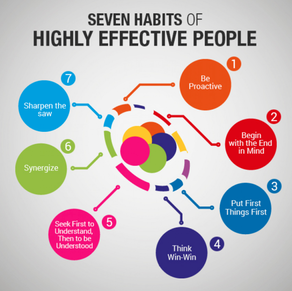
How to Lead Yourself and Others to Success: The 7 Habits of Highly Effective People, by Stephen Covey

3/6/2022

0 Comments

 
Picture
No better time than the new year and its traditional “good resolutions” to look back at Stephen Covey’s The 7 Habits of Highly Effective People. While similar books often provide little more than superficial hacks and tricks, the enduring success of this bestseller comes from the fact that Covey walks his reader through 7 life-changing realizations upon which to develop new dispositions aligned with the “natural laws” of personal and interpersonal growth.
Personality and Character Ethics
Good resolutions generally don’t work. The reason, if we follow Covey, is that they are usually limited to quick fixes and rather superficial changes, in line with the “Personality Ethic” that has become prominent after WWI, when it replaced a much more substantial approach rooted in “basic principles of effective living” ("Character Ethic"). According to Covey's review of over 200 years of writing on success, “people can only experience true success and enduring happiness as they learn and integrate these principles into their basic character.” This means two things: 
1) That “there are principles that govern human effectiveness--natural laws in the human dimension that are just as real, just as unchanging… as laws such as gravity are in the physical dimension”.
2) That success comes from developing habits, or rather dispositions that follow such rules of living. Indeed, the issue with resolutions is that they focus on starting / stopping particular actions, while effectiveness requires tackling the personal characteristics from which our behavioral patterns originate. 

Effectiveness and Success
What do “effectiveness” and “success” even mean? According to Covey, “effectiveness” can be defined with precision, down to a formula, as the optimal ratio between Production of desired results (P) and Production Capability (PC)—or, to follow Aesop, as the balance between the profitability and the welfare of the golden goose.

“If you adopt a pattern of life that focuses on golden eggs and neglects the goose, you will soon be without the asset that produces golden eggs. On the other hand, if you only take care of the goose with no aim toward the golden eggs, you soon won’t have the wherewithal to feed yourself or the goose”.

This P/PC balance is the fundamental principle of successful living. “It’s validated in every arena of life. We can work with it or against it, but it’s there. It’s a lighthouse. It’s the definition and paradigm of effectiveness upon which the Seven Habits in this book are based”.

But what is “success”? Is it limited to professional accomplishment and socio-economic status? No. Isn’t it different for every person? Yes. Isn’t it impossible to define in general, then? Not completely. The Second Habit will have each person clarify what “success” means for them but, according to Covey, true success can never mean just one thing. In line with the P/PC balance, or effectiveness principle, it requires a P/PC balance between everything in life.

“Many people seem to think that success in one area can compensate for failure in other areas of life. But can it really? Perhaps it can for a limited time in some areas. But can success in your profession compensate for a broken marriage, ruined health, or weakness in personal character?”

Habit #1 - Be Proactive
The first characteristic of highly effective people, according to Covey, is their can-do attitude. They are “proactive”, which means that they spend most of their time and energy on their "circle of influence", i.e., on the things, among those they care about (their "circle of concern"), which they can do something about. 
Like all Seven Habits, proactivity is a disposition that stems from a breakthrough, leading to a “paradigm shift”. Here, the “realization” is that we are responsible for who we are, because we are not the passive product of external factors, but the active product of our own reaction to given situations and creation of future circumstances.
More precisely, highly effective people distinguish, among the problems they face, between:
  • Those that involve their own behavior ("control area")
  • Those that involve other people’s behavior ("indirect control area")
  • Those they can do nothing about ("no control area")
Being proactive means solving the first by changing how we act (Habits #1, #2, and #3), addressing the second by changing how we interact with others (Habits #4, #5, and #6), and accepting the third by changing how we react to them (Habit #7, which also supports all the other ones).

Habit #2 - Begin With the End in Mind
The second characteristic of highly effective people, according to Covey, is that they are purposeful. A “can-do” attitude is a great start, but it won’t lead you very far unless you know what to do. Along with our free will (our ability to take initiative and make our own choices), we must therefore make use of our reflection (our capacity to represent the world in our mind and plan ahead). 
When he recommends that we “Begin with the End in Mind”, Covey is not only saying that we should work backwards from particular goals we set to the series of steps needed to achieve them. More essentially, he is saying that a successful life is a purposeful one. Enjoining his reader to think about what they would want 4 speakers (a family member, a friend, a colleague, and fellow member of some community organization) to say at their funeral, Covey invites us to a second paradigm shift: the realization of the finite nature of human existence, and thus of what matters and gives it meaning “in the end”—what it amounts to in terms of legacy. In a less dramatic (and morbid) way, Covey insists on the importance of writing a personal mission statement.

“The most effective way I know to Begin with the End in Mind is to develop a personal mission statement or philosophy or creed. It focuses on what you want to be (character) and to do (contributions and achievements) and on the values or principles upon which being and doing are based”.

Habit #3 - Put First Things First
The third characteristic of highly effective people, according to Covey, is that they are dedicated. Being proactive (taking control over one’s life) and purposeful (clarifying one’s life goals) is not enough to be effective and successful if one is not also intentional. Even planification is insufficient if one does not make time to take action, i.e., if one does not know how to prioritize. 
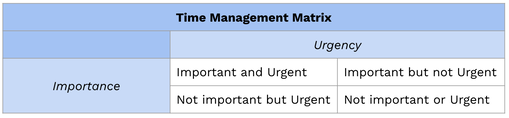
While he recommends using a time management matrix similar to the one below, Covey is not sharing a “productivity hack” (Personality Ethic), but inviting us to a third paradigm shift: a revolution in our relation to time, based on the realization that urgency and importance can be very different things.
Picture
Focusing our efforts on what is important and urgent rather than on what is only urgent or immediately satisfying is already an improvement. However, notes Covey, it is the top-right “important but not urgent” quadrant that we should pay special attention to. The reason is simple: because they are not urgent, we tend to kick these tasks down the road, attending instead to the constant updates to our time-sensitive to-do list. But they are not urgent because they have great, long-term benefits. Prioritizing by order of importance (rather than by time sensitivity or immediacy of rewards) is not only a profitable investment: it also progressively reduces the constant flow of things that have become urgent to do.

Habit #4 - Think Win-Win
The fourth characteristic of highly effective people, according to Covey, is that they are collaborative. Here again, the author invites us to a paradigm shift: most people, he argues, have a zero-sum game worldview, whereby one’s gain is everybody else’s loss. As a consequence, they approach everything as a competition. However, once we fully realize that our reality is fundamentally interdependent, we also understand that a “win-win” approach is the only road to success.

“In the long run, if it isn't a win for both of us, we both lose. That's why win-win is the only real alternative in interdependent realities.”

This fourth habit is another great example of the difference between superficial “success techniques” (Personality Ethic) and authentic principles of effectiveness (Character Ethic). The way Covey presents it, “win-win is not a technique; it's a total philosophy of human interaction… Win-win is a frame of mind and heart that constantly seeks mutual benefit in all human interactions.”
As economists have explained, competition stems from scarcity. Logically then, Covey invites his reader to adopt an “Abundance Mentality”.

“Win-win is based on the paradigm that there is plenty for everybody, that one person's success is not achieved at the expense or exclusion of the success of others.”

Habit #5 - Seek first to understand, then to be understood
The fifth characteristic of highly effective people, according to Covey, is that they are good communicators. The paradigm shift, however, is to understand that people communicate when they listen to each other— in line with the realization that effective interactions depend on our ability to access other people’s emotions, thoughts, and needs. How else could we achieve a “win-win”?
Listening is active, here. Yet, it is not the same as usual “active listening” techniques. Like all Seven Habits of highly effective people, empathic listening does not only require effort and practice, but also an authentic commitment. It is not a trick or even a shortcut for powerful human connections: it “involves patience, openness, and the desire to understand”, which come from a sincere interest in other people. This attention also constitutes a deposit in their “emotional bank account”, which they will appreciate and often reciprocate, thus creating a virtuous cycle also known as a successful relationship.

Habit #6 - Synergize
The sixth characteristic of highly effective people, according to Covey, is that they are “synergistic”, i.e., that they create synergy. The realization, here, is “that the whole is greater than the sum of its parts”. Indeed, synergy “means that the relationship which the parts have to each other is a part in and of itself. It is not only a part, but the most catalytic, the most empowering, the most unifying, and the most exciting part.”
This sixth habit is really the combination and culmination of all the previous ones. By changing other people’s paradigms and how they relate to each other, it helps create, through collaboration, the very abundance that collaboration needs to replace competition. As such, it is the secret to effectiveness and success, and its essence is “to value differences--to respect them, to build on strengths, to compensate for weaknesses” by creating environments of psychological safety and collective effervescence.

Habit #7 - Sharpen the Saw
The seventh and final characteristic of highly effective people, according to Covey, is that they are balanced. This is obviously in line with the P/PC principle of effectiveness: long-term success is impossible if you only “take care of business”, and never of yourself. If Habit #6 combined the previous five, Habit #7, supports all of them. To prevent burnout, Covey recommends that we practice self-care in “four dimensions of renewal”:
  • Physical (e.g., nutrition and sleep)
  • Spiritual (e.g., meditation)
  • Mental (e.g., education)
  • Social/emotional (e.g., social life)
The habit of “sharpening the saw” is in line with the fundamental paradigm shift (Character Ethic) inviting us to see success, not as the quick result of simple tricks, but as “a continuing process of renewal based on the natural laws that govern human growth and progress”, and thus as an “upward spiral of growth that leads to progressively higher forms of responsible independence and effective interdependence.”

Comment
Revisiting The 7 Habits of Highly Effective People 30 years after its publication, one understands why it became such a bestseller and instant classic. True enough, these 7 Habits are quite simple. However, many of the ideas contained in the book are now commonly known because Covey’s success made them so. What is more, the 7 Habits are not supposed to be particularly complex—they are supposed to be basic principles: natural laws of human effectiveness. Elementary, but true. That being said, intentionally or not, Covey does borrow from some of the main figures in the history of Western philosophy:  Aristotle, Descartes, Spinoza, Hegel, Nietzsche, Heidegger, and Sartre, to name a few.

Reference
Covey, S. (1990). The 7 habits of highly effective people: Restoring the character ethic. Free Press.
0 Comments

Your comment will be posted after it is approved.


Leave a Reply.

Proudly powered by Weebly
Photo from Gwydion M. Williams
  • Apps
  • AI Philosophy, Policies, and Competencies
  • AI-Powered UDL Strategies
  • LUDIA
  • AI Toolbox